
VIP member
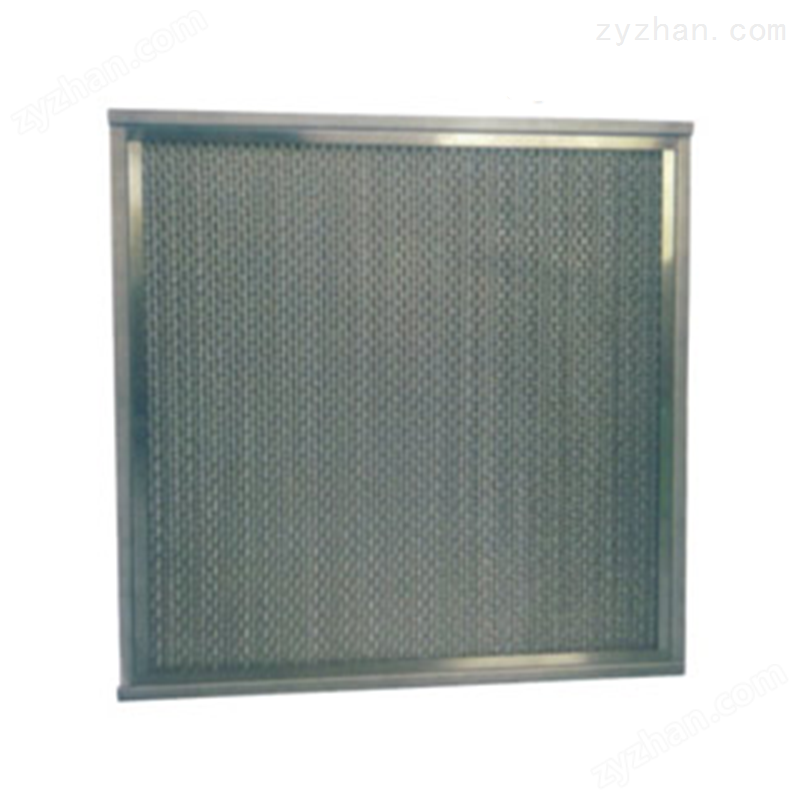

YTF high-efficiency air filter with separator
YTF pleated HEPA filters are available in paper pleated, aluminum foil pleated, and high-temperature resistant pleated filter types. They are used for
Product details
YTF HEPA Filters with Separators
HEPA filters with separators are divided into paper separator HEPA filters, aluminum foil separator HEPA filters, and high-temperature resistant separator filters. They are used for terminal filtration in cleanrooms of various levels and in various local purification equipment, such as clean benches and laminar flow hoods for environmental air purification.
HEPA filters with separators intercept airborne dust particles that move with the airflow through inertial motion, random Brownian motion, or under the influence of some field force. When these particles collide with other objects, the van der Waals forces (forces between molecules and molecular clusters) cause the particles to adhere to the fiber surface. Dust particles entering the filter media have more opportunities to collide with the media and become trapped. Smaller dust particles collide and agglomerate to form larger particles that settle, resulting in a relatively stable concentration of dust particles in the air. This is why indoor and wall fading occurs. It is a misconception to view fiber filters as simply sieves.
YTF HEPA Filter with Separators
HEPA Filter with Separators: Inertia and Diffusion
Particulate dust moves inertial motion in the airflow. When it encounters randomly arranged fibers, the airflow changes direction, and the particles, due to inertia, deviate from their direction and collide with the fibers, becoming adhered. Larger particles are more likely to collide, resulting in better filtration. Small dust particles undergo random Brownian motion. The smaller the particle, the more intense the random motion, the more opportunities to collide with obstacles, and the better the filtration effect. Particles smaller than 0.1 micrometers in the air mainly undergo Brownian motion; smaller particles result in better filtration. Particles larger than 0.3 micrometers mainly undergo inertial motion; larger particles have higher efficiency. Particles with little diffusion or inertia are difficult to filter. When measuring the performance of HEPA filters, the efficiency value for difficult-to-measure dust particles is often specified.
HEPA Filter with Separators: Electrostatic Effect
For various reasons, fibers and particles may become charged, producing an electrostatic effect. Electrostatically charged filter materials can significantly improve filtration performance. Reason: Static electricity causes dust to change its trajectory and collide with obstacles; static electricity also makes dust adhere more firmly to the medium. Materials that can generate static electricity are also called "electret" materials. When a material is charged with static electricity, its resistance remains unchanged, but the filtration effect is significantly improved. Static electricity does not play a decisive role in the filtration effect; it only plays an auxiliary role.
High-efficiency particulate air (HEPA) filters with separators are chemical filters. Chemical filters primarily selectively adsorb harmful gas molecules. Activated carbon materials contain numerous invisible micropores, providing a large adsorption area. In a grain of activated carbon the size of a rice grain, the micropore area is tens of square meters. Free molecules, upon contact with activated carbon, condense into liquid within the micropores and remain there due to capillary action; some even fuse with the material. Adsorption without obvious chemical reaction is called physical adsorption. In some cases, activated carbon is treated, causing the adsorbed particles to react with the material, generating solid substances or harmless gases; this is called chemical adsorption. The adsorption capacity of activated carbon continuously weakens during use; when it weakens to a certain level, the filter will become unusable. If it is only physical adsorption, heating or steam fumigation can remove harmful gases from the activated carbon, regenerating it.
Gravity effect in septum-type high-efficiency filters: When particles pass through the fiber layer, they are displaced from the airflow streamlines and settle on the fiber surface under the influence of gravity. This effect only exists when the particles are relatively large (>0.5µm), because the gravitational force on the particles is too weak, and they pass through the fiber layer with the airflow before settling onto the fibers. Therefore, for the filtration of particles smaller than 0.5µm, gravity settling is negligible.
Online inquiry
-
Contacts
-
Company
-
Telephone
-
Email
-
WeChat
-
Verification Code
-
Message Content
-