
VIP member
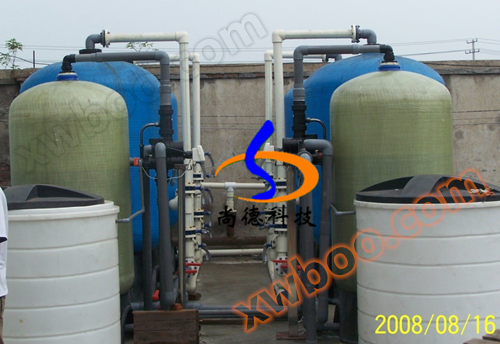
Textile softening water equipment
Due to the fact that the hardness of water is mainly formed and expressed by calcium and magnesium, cation exchange resins (water softeners) are gener
Product details

Due to the fact that the hardness of water is mainly formed and expressed by calcium and magnesium, cation exchange resins (water softeners) are generally used to replace Ca2+and Mg2+(the main components that form scale) in water. As the Ca2+and Mg2+in the resin increase, the efficiency of removing Ca2+and Mg2+gradually decreases.
After the resin absorbs a certain amount of calcium and magnesium ions, it must be regenerated. The regeneration process is to rinse the resin layer with saline solution in the salt tank, replacing the hardness ions on the resin. The resin is then discharged from the tank with the regeneration waste liquid, and the softening exchange function of the resin is restored.
fully automatic equipment
1. Users can choose manual control systems according to their situation to save costs.
2. If the user uses water continuously for 24 hours, they can choose to use alternate regeneration according to the water usage time, one for backup and one for use.
3. Users can also configure a first level multi-media filter according to their water quality requirements, which is used to remove sediment, rust, colloids, and suspended solids from the water; Secondary configurable activated carbon filter is used to remove pigments, odors, and biochemical organic compounds from water, reduce residual chlorine levels and pesticide pollution in water; Three level configuration of softened water equipment.
The effluent quality meets the national low-pressure boiler feedwater standard.
5. Time control - timed type; Flow control - metering type. In terms of operation, various combination methods such as single tank, double tank, and multi tank are adopted. When selecting, users can choose according to their needs. In terms of operation, this product not only has automatic operation function, but also can be manually operated.
Technical indicators and job requirements
Inlet water pressure: 0.18-0.6Mpa Operating temperature: 1-55 ℃
Source water hardness:<8mmol/L Operating mode: automatic/manual
Water hardness: ≤ 0.03mmol/L Regenerator: NaCl
Regeneration method: co current/counter current exchange agent: 001 * 7 strong acidic ion exchange resin
Control mode: time/flow
Working power supply: 220V/50Hz
Chemical equation for converting hard water to softened water
Calcium removal:
CaCO3+2NaCl=CaCl2+Na2CO3
Magnesium removal:
MgCO3+2NaCl=MgCl2+Na2CO3
Type of control valve for boiler softened water equipment
<1>; Semi automatic (manual) control valve
<2>; Fully automatic flow control valve
<3>; Fully automatic time type control valve
Regeneration process of boiler softened water equipment: edit
1. Backwash: After working for a period of time, the equipment will intercept a lot of dirt brought by the raw water on the upper part of the resin. After removing these dirt, the ion exchange resin can be fully exposed, and the regeneration effect can be guaranteed. The backwashing process is when water is washed in from the bottom of the resin and out from the top, which can wash away the dirt intercepted at the top. This process usually takes about 5-15 minutes.
2. Salt absorption (regeneration): The process of injecting salt water into a resin tank. Traditional equipment uses a salt pump to inject salt water, while fully automatic equipment uses a dedicated built-in sprayer to suck in salt water (as long as the inlet water has a certain pressure). In practical work, the regeneration effect of salt water flowing through the resin at a slower speed is better than simply soaking the resin in salt water. Therefore, softening water equipment adopts the method of slow flow of salt water through the resin for regeneration, which generally takes about 30 minutes. The actual time is affected by the amount of salt used.
3. Slow flushing (displacement): After flowing salt water through the resin, the process of slowly flushing all the salt in the resin with raw water at the same flow rate is called slow flushing. Due to the fact that a large number of calcium and magnesium ions on functional groups are still exchanged by sodium ions during this flushing process, according to practical experience, this process is the main process of regeneration, so many people call this process displacement. This process is generally the same as the salt absorption time, which is about 30 minutes.
4. Quick flushing: In order to thoroughly flush away residual salt, a flow rate similar to actual work should be used to flush the resin with raw water. The final effluent of this process should be soft water that meets the standard. Generally, the fast flushing process takes 5-15 minutes.
Online inquiry
-
Contacts
-
Company
-
Telephone
-
Email
-
WeChat
-
Verification Code
-
Message Content
-