|
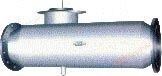
SQS series soda water mixerIt is a new type of energy-saving and environmentally friendly product that uses steam and water to directly mix and heat water. It has the characteristics of low noise, no vibration, high heat exchange efficiency, and energy saving. It is widely used in hot water and hot water heating and thermal deoxygenation systems for daily life and production. The heater is mainly composed of a nozzle, a shell, a mesh plate, a gasket, and other parts. When the heated water passes through the Lalar shaped nozzle, steam is sprayed into the water from the outside of the nozzle through many oblique small holes on the pipe wall. The two are instantly well mixed in high-speed flow to achieve the purpose of heating |
| . |
|
SQS series soda water mixer
Brief introduction
The SQS series soda water mixer is a new energy-saving and environmentally friendly product developed by our company. It uses steam and water to directly mix and heat water, and has the characteristics of low noise, no vibration, high heat exchange efficiency, and energy saving. It is widely used in hot water heating and thermal deoxygenation systems for daily life and production. Long term operation practice has proven that the product has good performance, especially after our company provided users with various valves, instruments, water pumps, temperature controllers, etc., which brought great convenience to users and ensured the normal operation of the system.
2、 Structure and principle
The mixer is mainly composed of a nozzle, a shell, a mesh plate, a gasket, and other parts. When heated water passes through a Laval shaped nozzle, steam is sprayed into the water through many oblique small holes on the pipe wall from the outside of the nozzle. The two mix well instantaneously in high-speed flow to achieve the purpose of heating water
By adjusting the steam side valve (manual or electric regulating valve), the desired temperature of hot water can be obtained.
3、 Job characteristics
For different models and specifications of heaters, in order to heat hot water at different temperatures, the required steam volume can be calculated by the following formula at the rated flow rate D1 (t/h):
D0=D1C1(T2-T1)/(i0'-C2T2)=D1(qT2-qT1)/(i'-C2T2)
In the formula:
Specific heat of C1 water at T1 temperature (KJ/Kg ·℃)
Specific heat of C2 water at T2 temperature (KJ/Kg ·℃)
T1- Inlet heater water temperature (℃)
T2- Water temperature after heating (℃)
| I '- enthalpy of saturated steam entering the heater at pressure P0 (KJ/Kg) |
4 |
6 |
8 |
10 |
12 |
16 |
20 |
24 |
32 |
40 |
48 |
| ● Open system steam consumption gauge (saturated steam pressure of 0.4MPa) |
1.2 |
2.5 |
4.5 |
7.0 |
10 |
16 |
25 |
35 |
60 |
105 |
165 |
| SQS- |
20 |
0.039 |
0.081 |
0.146 |
0.228 |
0.325 |
0.520 |
0.813 |
1.138 |
1.951 |
3.145 |
5.366 |
| 40 |
0.081 |
0.188 |
0.303 |
0.471 |
0.672 |
1.076 |
1.681 |
2.353 |
4.034 |
7.507 |
11.092 |
| 60 |
0.125 |
0.261 |
0.469 |
0.730 |
1.043 |
1.669 |
2.609 |
3.652 |
6.261 |
10.952 |
17.217 |
| 80 |
0.173 |
0.360 |
0.649 |
1.009 |
1.441 |
2.306 |
3.603 |
5.045 |
8.649 |
15.135 |
23.784 |
Rated inlet flow rate D
| one |
4 |
6 |
8 |
10 |
12 |
16 |
20 |
24 |
32 |
40 |
48 |
| Heating temperature difference ℃ |
1.2 |
2.5 |
4.5 |
7.0 |
10 |
16 |
25 |
35 |
60 |
105 |
165 |
| ● Steam consumption of circulation system t/h |
SQS- |
0.054 |
0.112 |
0.201 |
0.312 |
0.446 |
0.714 |
1.116 |
1.562 |
2.678 |
4.687 |
7.366 |
| Rated inlet flow rate D |
0.088 |
0.183 |
0.330 |
0.514 |
0.734 |
1.174 |
1.830 |
2.569 |
4.404 |
7.706 |
12.110 |
| one |
0.137 |
0.286 |
0.454 |
0.800 |
1.143 |
1.829 |
2.857 |
4.000 |
6.857 |
12.000 |
18.807 |
|
Heating temperature difference ℃
70-95
70-110
70-130
Installation and usage instructions
(1) The usage conditions of this device:
1. Safe operating conditions: Steam pressure entering the heater---
SQS-4~SW-24
P0≤1.6MPa, SQS-32~SQS-48 P0≤1.0MPa
2. Good operating conditions:
SQS-4~SQS-24 P1+0.05≤P0≤0.6MPa
In the formula: P0---- Steam working pressure (MPa)
SQS-32~SQS-48
P1+0.05 ≤ P0 ≤ 0.35MPa P1-- Inlet pressure (MPa)
For SQS-32-SQS-48 products in the circulation system, if the inlet pressure is high (cannot meet the requirements)
When P1+0.05 ≤ P0 condition, the heater should be installed on the suction side of the water pump, using hot water circulation
Ring pump to ensure good operation.
3 SQS-32~SQS-48, Generally, supports or piers should be installed on the ground, with a load of 500kg considered, SQS-4~SQS-24, Usually installed on wall brackets or other metal brackets.
4. The valves used in the mixer system can be installed in the designated locations according to the installation diagram
5. Start stop:
a. In an open system, first open the water side valve; Open the steam valve afterwards; When stopping operation, first close the steam valve and then close the water side valve.
b. In a circulatory system, the valves in the water pipeline are generally open, only the water pump is started and stopped. Therefore, when put into use, start the water pump first and then open the steam valve; Close the steam valve before stopping, and then
Stop the water pump.
 |
| 6. For hot water heating systems that frequently experience power outages, high-temperature solenoid valves should be installed on the steam pipelines. When there is electricity, the solenoid valve is in the room temperature position; When there is a power outage, the solenoid valve is closed |
Position, automatically cut off the steam source to ensure system safety. |
7. To prevent water from entering the steam pipe, a check valve should be installed near the heater on the steam pipe.
8. Water pressure loss: This heater is installed on the outlet side of the circulating water pump. When steam is not added, its pressure loss is 50KPa; When installed on the inlet side of the water pump without adding steam,
The pressure loss is about 0.15MPa. After adding temperature difference steam, its pressure loss is zero.
9. When using superheated steam as a heat source, to reduce noise, methods such as stepwise heating (segmented heating) or steam cooling can be adopted.
10. When starting to engage in exercise, there is a slight water hammer phenomenon, but it quickly disappears on its own.11. In an open system, the inlet pressure P1 is greater than 2.0kg/cm2. When using heating steam as the heat source, it should be heated in sections.
Figure 2 Heating Domestic Water (Open System)
Figure 3 Heating Domestic Water (Open System)
(2) Scope of application:
1. Used as a heating device in hot water heating systems, replacing traditional (indirect) water exchangers. (Figures 4 and 5)
|
2. Used for heating hot water in the bathroom and sending it to the water tank, replacing the high noise and strong vibration steam direct heating method (flower tube) in the hot water tank. (Figure 2)
|
3. Used for preheating soft water in deaerators (hot water deaeration). |
(3) Installation method: |
This device can be installed horizontally or vertically. |
| (4) In a hot water heating system powered by an electric pump, the conditions for installing this mixer on the inlet side of the water pump are as follows: |
A. The outlet water temperature of the mixer must be lower than the boiling water temperature at the inlet pressure of the water pump, that is, it cannot vaporize the water at the inlet of the water pump; |
B、 It must be lower than the operating temperature allowed by the water pump itself. |
(5) Valves, instruments, and attachments that must be set up in the system. |
Appendix: Ordering Supporting Valve Instrument List |
Steam side |
Inlet side |
Water outlet side |
Pipeline valve instrument usage system |
stop valve |
check valve |
solenoid valve |
| pressure gauge |
regulating valve |
stop valve |
pressure gauge |
thermometer |
stop valve |
pressure gauge |
thermometer |
Hot water heating circulation system |
√ |
√ |
※ |
| √ |
|
√ |
|
√ |
√ |
√ |
|
|
√ |
|
√ |
| √ |
Bathroom water heating system |
※ |
√ |
√ |
√ |
√ |
√ |
Preheating of deoxygenated water |
√ |
√ |
※ |
√
√
√
√
√
√
√
√
Note: 1. "※" indicates whether to adopt it based on the specific design.
Whether automatic control is installed for heating and deoxygenation shall be proposed by the specific design.
|
|