VIP member
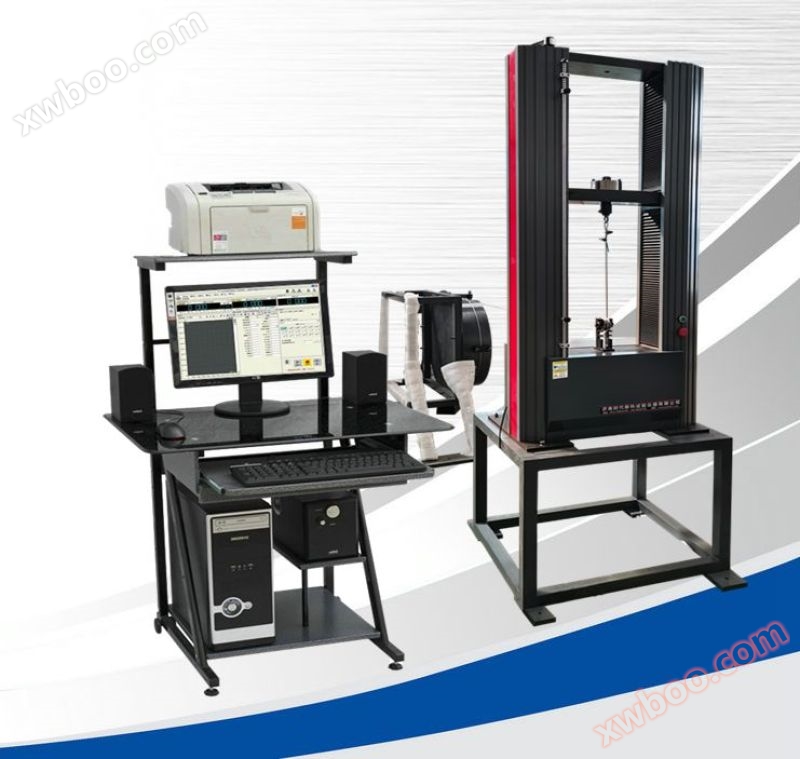
Silicon core tube dynamic friction coefficient testing machine (drum method)
The dynamic friction coefficient testing machine for silicon core tubes is mainly used for detecting the dynamic friction coefficient of silicon core
Product details
The dynamic friction coefficient testing machine for silicon core tubes is mainly used for detecting the dynamic friction coefficient of silicon core tubes. The machine can be used for multiple purposes and can also be used for physical performance indicators such as tensile yield strength, elongation at break, maximum traction load, ring stiffness, recovery rate, and connection force of tube joints for silicon core tubes and bundled tubes.
Test method for determining dynamic friction coefficient by drum method
1 Experimental equipment
Round drum, tensile testing machine, 20kg dedicated glare code, computer.
2 Sample requirements
2.1 Silicon core tube: Length 4RN.
2 . 2 Cable: A medium density polyethylene (MDPE) sheathed optical (electrical) cable with a diameter of (15 ± 2) mm and a length of 6m.
2.3 The inner surface of the silicon core tube and the outer surface of the optical (electrical) cable should not have any defects that may cause the optical (electrical) cable to slide.
2.4 U-shaped clamp: compatible with silicon core tube installation.
3 Experimental conditions
Before the experiment, the testing equipment and samples should be placed at a temperature of (23 ± 2) ℃ for 2 hours and tested at this temperature.
4 Experimental steps
4.1 Use U-shaped clamps to fix the silicon core tube on the circular drum stably to prevent relative movement between the silicon core tube and the drum during testing. The winding angle of the silicon core tube along the drum is 450 °
4.2 Place the cable into the silicon core tube, and the length of the cut cable should meet the maximum travel of the test.
4 . The clamp connected to the cable should be able to withstand the maximum tensile load tested.
4. Fix the dedicated brick code at one end of the cable, connect the horizontal end to the clamp, and connect the clamp to the tensile testing machine through a wire rope.
4.5 Turn on the tensile testing machine and set the stretching speed to 100mm/min. Stop stretching when the silicon code is just off the ground. Adjust the silicon core tube on the drum so that the two ends of the cable are in the middle of the silicon core tube.
4.6 Start the stretching program of the tensile testing machine at a speed of 100mm/min. Stop pulling when the crossbeam displacement is between 100mm and 120mm, lower the crossbeam of the tensile testing machine, and restart the stretching program of the tensile testing machine. Repeat this process twice in total to ensure that the cable is in full contact with the silicon core tube.
4.7 Lower the land code to ensure that the tensile testing machine is unloaded, and return the force and displacement of the tensile testing machine to zero.
4.8 Start the tensile program of the tensile testing machine and conduct a formal test at a tensile speed of 100mm/min. Stop pulling when the crossbeam displacement reaches 200mm, and read and calculate the average tensile load F of the tensile test in the displacement range between 100mm and 160mm. Calculate the dynamic friction coefficient of the silicon core tube according to the following formula.
M=ln(F/N)
θ
In the formula: μ - dynamic friction coefficient;
F - average tensile load, in newtons (N);
The gravity generated by a 20kg specialized weight, measured in newtons (N);
θ - the angle at which the silicon core tube is wrapped around the drum, with a value of 7 854rad 。
4 . This experiment was conducted three times, and the arithmetic mean of the three civil test results was taken as the dynamic friction coefficient.
Applicable standards:
JT/T 496-2018 Highway Underground Communication Pipeline High Density Polyethylene Silicon Core Plastic Pipe
GB/T 24456-2009 High Density Polyethylene Silicon Core Pipe
Main technical indicators:
Maximum test force (kN) |
20 (range optional) |
|
accuracy class |
Level 1 |
|
Test force measurement range |
0.4%-100% |
|
Relative error of test force indication |
<±1% |
|
Test force resolution |
1/500000 of the maximum test force |
|
Deformation measurement range |
2%-100% |
|
Relative error of deformation indication |
<±1% |
|
Deformation resolution |
Maximum deformation 1/500000 |
|
Relative error of displacement indication |
<±1% |
|
Displacement resolution (mm) |
0.001 |
|
speed range |
0.01-500mm/min |
stepless speed regulation |
Stretching stroke (mm) |
600 |
|
Compressed space (mm) |
700 |
|
Test width (mm) |
450 |
|
Can be equipped with fixtures |
Stretching, compressing, bending, shearing, peeling, tearing, etc |
|
Overall dimensions of the host (mm) |
770*540*1730 |
|
Servo motor power (kW) |
0.75 |
|
Total weight (kg) |
480 |
|
Online inquiry
-
Contacts
-
Company
-
Telephone
-
Email
-
WeChat
-
Verification Code
-
Message Content
-