
VIP member

PlantScreen Field based High throughput Phenotyping PlatForm
PlantScreen Field based High throughput Phenotyping PlatForm
Product details
PlantScreenField high-throughput plant phenotype analysis platform
——Field-based High-throughput Phenotyping PlatForm
Establishing the ability to rapidly, accurately, and high-throughput non damaging multi trait phenotype analysis of wild growing plants is the biggest challenge facing crop genetics and breeding in the 21st century (Andrade Sanchez et al. 2014, Furbank and Tester 2011, Houle et al. 2010). The field high-throughput plant phenotype analysis platform is of great significance for genetics, biotechnology, crop breeding, and monitoring of crop responses to climate change, soil, and cultivation management, especially in modern agriculture and smart agriculture.
PlantScreenThe field high-throughput plant phenotype analysis platform integrates modern advanced technologies such as automatic control system, chlorophyll fluorescence imaging measurement and analysis, plant thermal imaging analysis, plant hyperspectral analysis, RGB color imaging analysis, and Internet+phenotype big data platform, to achieve in situ high-throughput phenotype analysis and measurement of field plants, plant stress response and crop resistance imaging analysis, measurement and screening, plant growth analysis and measurement, character recognition, plant physiological and ecological analysis and research in an optimized way. As the world's first manufacturer to develop and produce plant chlorophyll fluorescence imaging systems, PSI company is at the forefront of technology in the field of plant phenotype imaging analysis. Large area chlorophyll fluorescence imaging analysis and other imaging analysis platforms enablePlantScreenBecoming the most advanced instrument and equipment for plant phenotype analysis and functional imaging analysis.

Functional features:
1) A large-scale multifunctional sensor platform that integrates chlorophyll fluorescence imaging, RGB imaging, infrared thermal imaging LiDAR、 Various advanced high-end sensing devices such as hyperspectral imaging, comprehensively analyze:
a) Phenotypic analysis of structural traits (RGB imaging and LiDAR)
b) Functional phenotype analysis (chlorophyll fluorescence imaging)
c) Shape and Growth Assessment (RGB Imaging and LiDAR)
d) Photosynthesis performance (chlorophyll fluorescence imaging)
e) Biological stress and abiotic stress response (chlorophyll fluorescence imaging, hyperspectral imaging, infrared thermography)
f) Physiological and ecological manifestations include photosynthetic physiology, stomatal dynamics, biochemical metabolic indicators, etc. (chlorophyll fluorescence imaging, hyperspectral imaging, infrared thermography)
2) The globally leading FluorCam chlorophyll fluorescence imaging technology is an essential analysis technology for crop physiological and ecological functional traits. The intelligent LED light source provides modulated measurement light, which can automatically image and measure chlorophyll fluorescence and photosynthetic efficiency under light adaptation conditions during the day; Equipped with a unique high-sensitivity chlorophyll fluorescence imaging lens, with an imaging area of 35cm x 35cm (customizable 80cm x 80cm), it is the world's largest technology equipment for single chlorophyll fluorescence imaging area
3) It can be installed on a tractor for mobile automatic imaging analysis, or installed on a dedicated automatic operation platform to automatically run along the sample track while performing full coverage automatic scanning imaging and online analysis of the sample
4) Phenotype analysis big data platform, including system control, data collection, data processing analysis and visualization online display, database, etc
5) The expert team of PSI Phenotype Research Center provides technical support and organizes an annual World Plant Phenotype Symposium in the United States and Europe respectively
6) Optional PhenoUAS high-throughput phenotype analysis platform based on UAV technology, enabling ground-based phenotype analysis scaling up to rapid phenotype analysis in large aerial areas
7) Optional soil meteorological monitoring station to comprehensively analyze the relationship between environmental conditions and phenotypic traits
8) Optional plant physiological and ecological monitoring system, synchronously monitoring plant photosynthesis and fruit growth information
9) Optional automatic weighing digital cultivation pot for precise weighing, soil moisture monitoring, automatic watering, etc
Main technical indicators:
1. The integrated multifunctional automatic imaging analysis platform integrates intelligent LED light sources, chlorophyll fluorescence imaging modules, RGB imaging analysis modules, and other optional imaging modules such as infrared thermal imaging, LiDAR laser scanning, hyperspectral imaging, etc. It runs automatically, classifies and stores automatically, and performs online analysis through the operating system
2. Chlorophyll fluorescence imaging analysis (standard):
a) 3-color intelligent LED excitation light source, 620nm pulse measurement light, white photochemical light and maximum saturation flicker, 735nm infrared light for measuring Fo ', etc
b) Optional blue light source and 7-bit filtering wheel for multispectral and multi band fluorescence measurement, such as GFP imaging measurement
c) Unique high-sensitivity CCD chlorophyll fluorescence imaging sensor, with a frame rate of 50fps, effectively captures chlorophyll fluorescence transients, resolution of 720x560 pixels, A/D 12 bits, and video mode and snapshot mode; Optional high-resolution CCD, resolution 1360x1024, frame rate 20fps, A/D 16 bit
d) Single imaging area 35x35cm
e) Imaging measurement parameters: can be used for night adaptation measurement and day light adaptation measurement, and the measurement parameters include Fo, Fm, Fv, Fo’, Fm’, Fv’, Ft, Fv/Fm, Fv’/Fm’, Phi_PSII, NPQ, qN, qP, Rfd Chlorophyll fluorescence parameters are used to analyze plant photosynthetic efficiency, fitness, biotic and abiotic stress, crop resistance, resilience, etc
f) Complete automated measurement protocols and parameters such as Fv/Fm, Kautsky induction effect, fluorescence quenching analysis, etc., with a measurement time of only 10 seconds for Fv/Fm programs
g) Online analysis of chlorophyll fluorescence data, including bar charts, measurement parameter graphs, data tables, etc., with custom image segmentation and other functions, can perform multi parameter dynamic analysis at different time scales (such as day, month, entire growing season, etc.)

h) It is a true two-dimensional synchronous imaging, and the chlorophyll fluorescence parameters obtained are truly pixel based two-dimensional distribution parameters, avoiding simplified "laser-induced imaging" (advantages are lightweight and energy-saving). It only has one-dimensional imaging (points or lines), cannot synchronize two-dimensional imaging, and is easily affected by environmental factors (such as wind and grass movement causing serious errors). The imaging parameters are only simulation parameters (the fast measured fluorescence and slow measured fluorescence obtained from laser scanning speed are not the true minimum and maximum fluorescence, and the obtained parameter "photon yield" only needs to be calibrated to simulate photon yield before use). The measurement parameters are single (can only obtain fast measured fluorescence and slow measured fluorescence, as well as the simulated photon yield or photon efficiency calculated from them). The Problems such as immature technology (unable to find references)
i) It is the most widely used and published technology for high-throughput phenotype analysis of plants in the world
3. RGB imaging analysis (standard): It can perform imaging analysis on the shape, color, and greenness of plants with a resolution of 5Mpx, and can automatically perform statistical analysis on the number of plant flowers, rice tillers, etc. The main analysis and measurement parameters include:
1) Leaf Area: Useful for Monitoring Growth Rate and Its Dynamic Changes
2) Solidity/Compactness. Ratio between the area covered by the plant's convergence hull and the area covered by the actual plant
3) Leaf Perimeter: Partially useful for the basic leaf shape and width evaluation (combined with leaf area)
4) Eccentricity: Plant shape estimation, scale number, eccentricity of the ellipse with same second moments as the plant (0... circle, 1... line segment)
5) Roundness: Based on evaluating the ratio between leaf area and perimeter. Give information about leaf roundness
6) Medium Leaf Width Index: Leaf area proportional to the plant skeleton (i.e. reduction of the leaf to line segment)
7) Slenderness of Leaves (SOL)
8) Circle Diameter of a circle with the same area as the plant
9) Convex Hull Area. Useful for compactness evaluation
10) Centroid. Center of the plant mass position (particularly useful for the eccentricity evaluation)
11) Flattening index
12) Relative growth rate
13) Green Index and Grading Analysis (Dark Green, Healthy Green, Light Green, etc.)
14) Color segmentation for plant fitness evaluation
15) Dynamic analysis of other traits and color grading

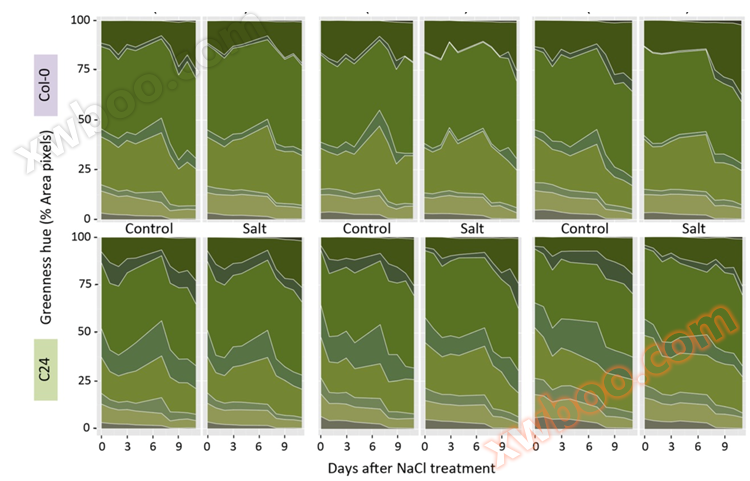
4.3D laser scanning analysis (optional): used for plant structural phenotype analysis, automatically analyzing and calculating various morphological structural parameters such as plant structure, biomass, leaf number, leaf area, leaf inclination angle, plant height, etc. through point cloud model

5. Infrared thermal imaging analysis (optional): Focal plane array microcalorimeter, resolution 640 × 480 pixels, band 7.5-13 μ m, temperature range -20-120 ℃, resolution<0.05 ℃ @ 30 ℃/50mK, imaging area 35x35cm, used for imaging the canopy temperature distribution of plants under light radiation, and analyzing the dynamic stomatal conductance, drought stress, and drought resistance evaluation of plants. Good heat dissipation can enable plants to tolerate long periods of high light radiation or low water conditions (drought)
6. Hyperspectral imaging analysis (optional): wavelength range of 380-1000nm, 675 spectral bands, capable of imaging and analyzing Normalized Difference Vegetation Index (NDVI), Simple Ratio Index (Equation: SR=RNIR/RRED), Modified Chlorophyll Absorption in Reflectance Index (MCARI1), Equation: MCARI1=1.2 * [2.5 * (R790- R670) -1.3 * (R790- R550)], Optimized Soil Adjusted Vegetation Index (OSAVI) , Equation: OSAVI=(1+0.16) * (R790- R670)/(R790- R670+0.16), Photochemical Reflectance Index (PRI), Equation: PRI=(R531- R570)/(R531+R570), etc

7. Field mobile platform: The platform arm has a span of 12m, and the multifunctional imaging platform can automatically scan and analyze images left and right on the mobile platform. It can automatically scan sample strips with a width of up to 10m, and the imaging area can reach 10x0.35m (3.5m2) per scan. The completion time of one scan ranges from less than 1 minute to several minutes (depending on the experimental measurement program Protocol). The mobile platform can automatically run along the track, and the running distance is generally not limited (limited by the length of the track); The height of the mobile platform is 2.5m, and the height of the multifunctional imaging platform can be adjusted to adapt to crop imaging analysis at different heights; The four rubber wheels of the mobile platform can not only automatically operate and scan images on the track through the control system, but also facilitate movement and turning on general ground. For a 75x20m sample plot, the mobile platform can load a multifunctional imaging platform to complete a 75x10m sample strip at once, and then manually turn and automatically complete the imaging analysis of the other half of the 75x10m; Equipped with a GPS system with an accuracy of 2cm, it automatically records measurement data, location, time, etc. through software, and can be powered by a diesel generator to drive the entire platform to move
8. Optional environmental measurement sensor network can automatically monitor and record PAR, environmental CO2 concentration, air temperature and humidity, rainfall, soil moisture, etc.
9. System Control and Data Collection Analysis System (Phenotype Big Data Platform):
1) User friendly graphical interface
2) The GPS positioning function can analyze spatial distribution information and spatiotemporal distribution patterns
3) It has various mature protocols built-in, with user-defined and editable automatic measurement programs (protocols), which automatically complete all experiments according to the user's set program. The data results are automatically stored and analyzed, and the analyzed data results can be automatically displayed in the form of dynamic curves
4) MySQL database management system, capable of handling large databases with millions of records, supports multiple storage engines, and automatically stores relevant data in different tables in the database
5) All measurements can be performed using the default program, or custom workflows can be created through development tools, or manually operated to turn on or off LED light sources, RGB scanning imaging, chlorophyll fluorescence imaging, etc
6) The experimental protocols have start, end, and pause keys
7) The system can be controlled wirelessly and remotely through the Internet, allowing users to access the data remotely through the Internet, perform data processing, download and change the experimental design, and has the user authority grading function to prevent other personnel from misoperation affecting the experiment


Origin: PSI Europe
Application case:
Application FluorCamChlorophyll fluorescence technology is used for in situ long-term monitoring of wild plants in different seasons, while also monitoring plant photosynthesis (CO2 assimilation) A. The results are shown in the following figure. FluorCam chlorophyll fluorescence technology adopts excitation light pulse modulation technology, high-sensitivity CCD sensor (sampling frequency up to 50 times per second) technology, and intelligent LED light source, which can cover a large area (standard imaging area per frame is 35x35cm) Plant/crop imaging analysis can perform chlorophyll fluorescence imaging analysis under dark adaptation conditions in the field, as well as under ambient light adaptation conditions. Compared with simple laser-induced chlorophyll fluorescence measurement (which excites chlorophyll fluorescence through a point or linear monochromatic excitation light source and measures it, the advantage is that it is energy-saving and can be more lightweight), it has many functional advantages. It not only has more measurement parameters and can perform various chlorophyll fluorescence experimental program imaging measurement analysis, but also avoids problems such as asynchronous chlorophyll fluorescence measurement caused by point or linear excitation light scanning and serious reduction in outdoor wind blown grass movement resolution in one two-dimensional imaging (true imaging analysis).


Attachment: Other field phenotype imaging analysis systems:
1)PhenoUASUnmanned aerial vehicle high-throughput field crop phenotype analysis platform
2)FluorCamField mobile chlorophyll fluorescence and RGB imaging analysis system
3)FluorCamSample scanning chlorophyll fluorescence and RGB imaging analysis system (optional infrared thermal imaging)

Online inquiry
-
Contacts
-
Company
-
Telephone
-
Email
-
WeChat
-
Verification Code
-
Message Content
-