
VIP member
Product details
Methanol Chromatography Analyzer
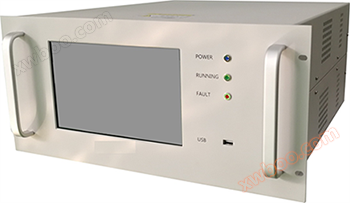
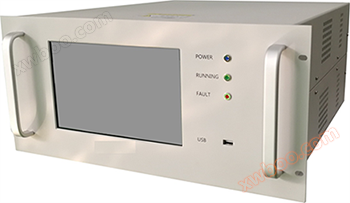
The SY-VOC900 methanol chromatograph is equipped with an enrichment device, which can continuously measure trace amounts of methanol concentration in the air.
A gas chromatograph consists of valves, column boxes, detectors, gas path control systems, and computer control systems. Adopting exquisite structural design and standard cabinet size, it fully meets the requirements of online use. The detector is a hydrogen flame ionization detector (FID). The gas path control is completely EPC controlled, which can achieve fully automated flow regulation. The computer control system of methanol chromatograph adopts a combination of microcomputer and dedicated software to stabilize temperature control of valve box, column box, detector, as well as flow control of the entire pipeline, ensuring the reliability and repeatability of the instrument.
Instrument features:
u The capillary column chromatography column has a uniquely designed blowback function to ensure the reliability of the column and eliminate interference from other substances.
u Range can be selected on-site
u Automatic calibration and span detection
u Real time calibration chart
u Users can adjust response time and average time
u Can be customized according to customer requirements at will
Range: methanol 0-5mg/m3 can be set
Detector: Hydrogen Flame Ionization Detector (FID)
Analysis cycle:<30 minutes
Color column: capillary chromatography column
Injection method: automatic enrichment and thermal desorption
Temperature control range: 0 ℃ to 350 ℃ at room temperature, with 10 linear heating stages
Temperature control accuracy: within 100 ℃, the accuracy is ± 0.1 ℃
The accuracy is ± 0.2 ℃ within the range of 100 ℃ to 350 ℃
Heating rate range: adjustable from 0-200 ℃/min, with an adjustment amount of 0.1 ℃/min
Valve box temperature control range: 5 ℃ to 180 ℃ at room temperature
Baseline noise of hydrogen flame ionization detector (FID): ≤ 5 × 10-14A;
Baseline drift: ≤ 3 × 10-13A/30min;
Detection limit: DFID ≤ 2.5 × 10⁻¹² gc/s (with nitrogen as the carrier gas).
Zero point noise: 0.04PA
Minimum detection limit:<5ppb
Indication error: within 2%
Repeatability: RSD ≤ 1%
Gas source;
Carrier gas: high-purity nitrogen (≥ 99.999%);
Combustion gas: high-purity hydrogen gas (≥ 99.999%);
Auxiliary gas: Zero grade air (hydrocarbons<20ppb)
Output: 4~20mA, RS232/RS485, Ethernet
Power supply:<300W, 220V AC/50Hz
Working environment: Temperature: (5~35) ℃, Humidity: (10%~90%) RH
Analysis cycle: 24-hour continuous sampling.
Enrichment pre concentration system
1)Sampling method
The sample is first dehydrated using a low-temperature water removal pipe, and then sampled using a low-temperature trap to enrich the target compound (as shown in the figure below). The enriched sample is then analyzed by thermal analysis on a chromatographic column. The instrument can measure hydrocarbons, volatile organic compounds containing oxygen/nitrogen, and halogenated hydrocarbons in the range of C2-C12, and can effectively analyze and detect all target analytes.
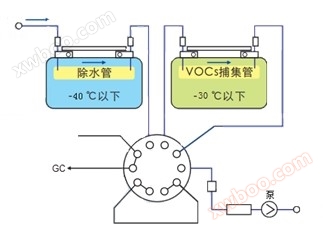
Schematic diagram of cold trap capture
2)Capture system
The low-temperature enrichment factor can reach 50 times that of room temperature; Adopting cryogenic water removal technology, the water removal efficiency is higher than 99%; The phenomenon of chromatographic peak drift after water removal is effectively suppressed.
Real time monitoring of sampling flow using high-precision electronic flow modules, precise control of sampling volume;
runtime environment
a)Temperature range: 15~35 ℃
b)Power supply: 220VAC ± 10%, 50Hz
Enrichment device
a)Capture trap temperature range: -35 ℃~400 ℃
b)Flash evaporation heating rate:>100 ℃/s
c)Enrichment time: 0-60 minutes (adjustable)
d)Interval time: 0-60min (adjustable)
e)Injection time: 0-10 minutes (adjustable)
F)Sampling time: 0-60min (adjustable)
Online inquiry
-
Contacts
-
Company
-
Telephone
-
Email
-
WeChat
-
Verification Code
-
Message Content
-