
VIP member
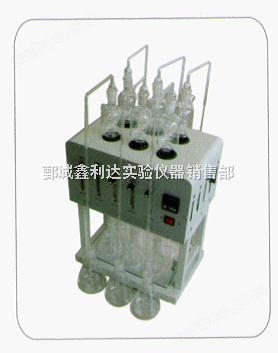
High chlorine wastewater analyzer
Execution standard: HJ/T70-2001 Determination of Chemical Oxygen Demand for High Chlorine Wastewater - Chlorine Calibration Method. When the chloride
Product details
High chlorine wastewater analyzerMain indicators
1Traffic indicators:5-40ml/min
2Temperature range:32
3Set time:0-999Minutes of any setting
4Number of dissolved samples:6A(1A blank sample
5Dissolving volume:250ml
6Power supply:AC220V 50Hz
7Total gas flow rate:
8Flow regulation channel:5road
High chlorine wastewater analyzerTechnical features:
1Can be correct6Simultaneously heating a conical reflux device for digestion,1A blank sample
2No need to pour into other bottles, the triangular cup can be measured after heating, making it convenient to use
3Energy saving, reducing power load, and improving efficiency
4Using high-precision flow meters to regulate nitrogen injection volume
5Thorn reflux tube with good cooling effect
6Independent channels that do not interfere with each other.
Under alkaline conditions, add a certain amount of potassium permanganate solution to the water sample and heat it in a boiling water bath for a certain period of time to oxidize the reducing substances in the water. Add excess potassium iodide to reduce the remaining potassium permanganate, use starch as an indicator, titrate the released iodine with sodium thiosulfate, convert it to oxygen concentration, and express it as CODOH.KI. Weigh 1.0g of soluble starch, mix it into a paste with a small amount of water, and dilute it to 100ml with just boiled water. After cooling, add 0.4g of zinc chloride for preservation or prepare it as needed. Weigh 6.2g of sodium thiosulfate (Na2S2O3 • 5H2O) and dissolve it in boiling and cooled water. Add 0.2g of sodium carbonate and dilute with water to 1000ml. Store in a brown bottle. Before use, calibrate with a 0.025mol/L potassium dichromate standard solution. The calibration method is as follows: add 100ml of water and 1.0g of potassium iodide to a 250ml iodine volumetric flask, add 10.00ml of 0.025mol/L potassium dichromate solution, then add 5ml of 15 sulfuric acid solution and shake well. After standing in the dark for 5 minutes, titrate with the sodium thiosulfate solution to be calibrated until the solution turns light yellow. Add 1ml of starch solution and continue titration until the blue color just fades away. Record the amount used. Calculate the concentration of sodium thiosulfate solution using the following formula: C=10.00 × 0.0250/V
Sample pretreatment
If the water sample contains oxidizing substances, sodium thiosulfate should be added to the water sample in advance to remove them. First, transfer 100ml of water sample into a 250ml iodine volumetric flask, add 0.5ml of 50% sodium hydroxide solution, and shake well. Add 0.5ml of 4% sodium azide solution, shake well, and measure according to steps 10.4 to 10.6. Record the amount of sodium thiosulfate solution used.
Take another water sample, add the amount of sodium thiosulfate solution mentioned in section 8.1, shake well, and let it stand. Afterwards, follow step 10 to measure.
Experimental steps
⑴ Take 1/10 of the volume of waste water sample and reagent required for the above operation, shake well in a 15 × 150mm hard glass test tube, heat and observe whether it turns green. If the solution turns green, reduce the amount of wastewater sampling appropriately until the solution remains green, in order to determine the volume that should be taken for wastewater analysis.
When the chloride ion content in the wastewater exceeds 30mg/L, 0.4g of mercuric sulfate should be added to the reflux conical flask first, and then diluted with an appropriate amount of wastewater to 20.00mL.
⑶ Take 20.00mL of evenly mixed water sample and place it in a reflux conical flask. Accurately add 10.00mL of potassium dichromate standard solution and several washed glass beads or zeolites. Add 30mL of sulfuric acid silver sulfate solution from the upper opening of the condenser tube, shake the conical flask to mix the solution, and heat reflux for 2 hours (timed from the beginning of boiling).
After cooling, slowly rinse the condenser tube wall from the top with 90mL of water and remove the conical flask.
After the solution is cooled again, add 3 drops of ferrous sulfate indicator solution and titrate with ferrous ammonium sulfate standard solution. The color of the solution changes from yellow to blue-green to reddish brown, which is the endpoint. Record the amount of ferrous ammonium sulfate standard solution used.
At the same time as measuring the water sample, conduct a blank test using 20.00mL of distilled water and follow the same procedure. Record the amount of ferrous ammonium sulfate standard solution used for titration blank.
Online inquiry
-
Contacts
-
Company
-
Telephone
-
Email
-
WeChat
-
Verification Code
-
Message Content
-