
VIP member

Evaporative wet film humidifier
1、 Evaporative wet film humidifier is an isentropic humidification method, in which the evaporation of moisture is achieved by absorbing energy from t
Product details
 Evaporative wet film humidifier
1、 Evaporative wet film humidifier
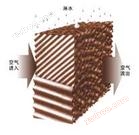 Evaporative wet film humidifier is an isentropic humidification method, in which the evaporation of moisture is achieved by absorbing energy from the air. At this time, the dry bulb temperature of the air decreases, while the absolute moisture content in the air increases, but the enthalpy value of the air remains unchanged. This humidification method has been widely used both internationally and domestically.
The humidifier sends water to the top of the wet film through a water supply pipeline or a circulating water supply pump system, and sprays it downwards through small holes on the water distribution pipe. The water is evenly distributed and supplied to the humidifying medium through a hydrophobic medium. The humidifying medium provides a large contact area between air and water, forming a water film. Through continuous flow of water, it exchanges heat and humidity with the air, achieving the functions of humidification and self-cleaning.
Humidifier core component wet material
The core component of the evaporative wet film humidifier is the core material. Our company can provide customers with three types of wet materials: organic, inorganic, and metal materials, which can meet the diverse needs of users.

2、 Superior performance of evaporative wet film humidifier
● High saturation efficiency
Humidifiers distribute water evenly onto the humidifying medium through a water distributor, and the humidifying medium has a large evaporation area, resulting in high saturation efficiency; The saturation efficiency is constant and not affected by the inlet temperature and humidity of the air. Even under low temperature and high humidity conditions, reliable humidification performance can be maintained.
● Clean humidification
Due to the complete gasification of water molecules, there is no need to worry about the occurrence of "white powder" phenomenon. The water film formed on the surface of the humidifying medium has the functions of dust removal and deodorization, which can eliminate dust, bacteria, etc. in the air and discharge them through the unevaporated water. If disinfection devices (such as chlorine containing agents or ozone) are installed in the water supply system, the air conditioning system can be thoroughly disinfected.
● Save space
The humidifier air outlet has no water droplets floating, the humidification absorption distance is short, the airflow direction is evenly organized, and the external dimensions of the air conditioner are reduced.
● No condensation phenomenon
The relative humidity of the air at the outlet of the humidifier will not be supersaturated, and there will be no re condensation or condensation phenomenon.
● Easy to maintain
The humidifier has a simple structure and does not require any handling, making it easy to maintain.
● Wide range of applications
It can be used with various types of ordinary air conditioners and can also be used for non-standard products.
Self regulating humidification ability
Due to the relatively stable saturation efficiency, it can self adjust even if there are changes in the air inlet temperature, humidity, or humidification level.
● Good cooling effect
Due to its use of evaporation principle to absorb sensible heat from the air, it has a significant cooling effect, especially suitable for cooling in dry areas of northwest China, which can save energy. Each liter of water evaporated can obtain the equivalent of 7 kilograms of melted ice, but the cost is only one tenth of compression refrigeration.
The working principle diagram is as follows:
3、 Wind resistance and saturation efficiency table of evaporative wet film humidifier:
|
Wet film thickness (mm)
|
50
|
80
|
100
|
150
|
200
|
300
|
|
Pressure loss (pa)
|
35
|
45
|
53
|
80
|
125
|
200
|
|
Saturation efficiency (%)
|
40
|
50
|
60
|
75
|
85
|
95
|
|
test conditions
|
The wet material is inclined at a 45 degree angle, with a wind speed of 2.5m/s. The temperature and humidity of the air dried bulb are 35 ℃ and 5% RH, and the temperature and humidity of the air dried bulb are 20 ℃ and 55% RH.
|
|||||
4、 Water supply method of evaporative wet film humidifier
(1) Direct drainage method
1. Installation diagram:

2. Electrical control schematic diagram:

(2) Internal circulation water supply method
1. Installation diagram:

(3) Internal and external circulation water supply
Installation diagram:

5、 Evaporative wet film humidifier model:

6、 Quick selection table for evaporative wet film humidifier:
| Air conditioning unit air volume m3/h |
Humidification rate kg/h
|
SM-60 | SM-80 | SM-100 | SM-120 | SM-150 | SM-200 | SM-300 |
| 2000 | 0.22 | 7.3 | 9 | 11 | 13 | 15 | 18 | 19 |
| 2500 | 0.28 | 9.2 | 11.5 | 13.5 | 16 | 18 | 22 | 24 |
| 3000 | 0.33 | 11 | 13.5 | 16 | 20 | 22 | 27 | 29 |
| 3500 | 0.39 | 13 | 16 | 19 | 23 | 26 | 32 | 34 |
| 4000 | 0.44 | 15 | 18.5 | 22 | 26 | 30 | 36 | 39 |
| 4500 | 0.5 | 16 | 20 | 24 | 29 | 33 | 41 | 44 |
| 5000 | 0.56 | 18 | 22.5 | 27 | 33 | 37 | 45 | 49 |
| 5500 | 0.61 | 20 | 25 | 30 | 36 | 41 | 49 | 54 |
| 6000 | 0.66 | 22 | 27 | 32 | 40 | 44 | 54 | 59 |
| 6500 | 0.72 | 24 | 29 | 35 | 43 | 48 | 59 | 64 |
| 7000 | 0.78 | 25 | 31.5 | 38 | 46 | 52 | 63 | 69 |
| 7500 | 0.83 | 27 | 34 | 41 | 49 | 56 | 67 | 74 |
| 8000 | 0.89 | 29 | 36 | 44 | 52 | 60 | 72 | 79 |
| 8500 | 0.94 | 30 | 38 | 46 | 55 | 67 | 76 | 84 |
| 9000 | 1 | 32 | 40.5 | 49 | 59 | 67 | 81 | 89 |
| 9500 | 1.06 | 34 | 43 | 52 | 62 | 71 | 85 | 94 |
| 10000 | 1.11 | 36 | 45 | 54 | 66 | 74 | 89 | 99 |
| 15000 | 1.67 | 55 | 68 | 81 | 99 | 111 | 133 | 149 |
| 20000 | 2.22 | 73 | 90 | 108 | 132 | 148 | 178 | 199 |
| 25000 | 2.8 | 91 | 113 | 135 | 165 | 185 | 225 | 249 |
| 30000 | 3.33 | 108 | 135 | 162 | 198 | 222 | 270 | 298 |
| 35000 | 3.9 | 127 | 156 | 189 | 231 | 259 | 315 | 346 |
| 40000 | 4.44 | 146 | 181 | 216 | 264 | 296 | 360 | 392 |
Note: Test condition: t=35 ℃, diameter=5% RH, v=2.5m/s, t2=20 ℃, diameter=5% RH
1. Operating conditions:
Before humidification: t=35 ℃, φ=5% RH, V=6000m3/h
After humidification: t=20 ℃, diameter=55% RH, wind speed=2.5m/h
2. Calculate the required humidification amount according to the formula: (fresh air)
W=V·P·(d2-d1)
=6000·1.2·(0.0077-0.0017)
=43.2kg/h
3. As the fresh air volume of the air conditioner is 6000m3/h and the effective humidification capacity is 43.2kg/h, according to Table (2), the corresponding wet film model is SM-150
4. Empirical formula for calculating partial fresh air humidification: W=P × V × fresh air ratio × 1.5 × (d2-d1)
7、 Technical parameter table of evaporative wet film humidifier
1. Operating conditions:
Before humidification: t=35 ℃, φ=5% RH, V=6000m3/h
After humidification: t=20 ℃, diameter=55% RH, wind speed=2.5m/h
2. Calculate the required humidification amount according to the formula: (fresh air)
W=V·P·(d2-d1)
=6000·1.2·(0.0077-0.0017)
=43.2kg/h
3. As the fresh air volume of the air conditioner is 6000m3/h and the effective humidification capacity is 43.2kg/h, according to Table (2), the corresponding wet film model is SM-150
4. Empirical formula for calculating partial fresh air humidification: W=P × V × fresh air ratio × 1.5 × (d2-d1)
7、 Technical parameter table of evaporative wet film humidifier
| wind speed | SM—60 | SM—80 | SM—100 | SM—120 | SM—150 | SM—200 | SM—300 | |||||||
| or | W1 | or | W1 | or | W1 | or | W1 | or | W1 | or | W1 | or | W1 | |
| 2 | 38 | 34 | 47 | 42 | 57 | 51 | 67 | 60 | 77 | 69 | 87 | 83 | 98 | 93 |
| 2.5 | 37 | 32 | 46 | 40.5 | 55 | 49 | 66 | 59 | 75 | 67 | 85 | 81 | 95 | 89 |
| 3 | 36 | 32 | 45 | 39 | 54 | 48 | 65 | 58 | 73 | 65 | 83 | 78 | 92 | 87 |
| 3.5 | 35 | 31 | 44 | 38.2 | 53 | 47 | 64 | 57 | 72 | 64 | 82 | 76 | 89 | 85 |
| 4 | 34 | 30 | 43 | 37 | 52 | 46 | 63 | 56 | 71 | 63 | 81 | 74 | 86 | 83 |
| 4.5 | 33 | 29 | 42 | 36 | 51 | 45 | 62 | 55 | 70 | 62 | 80 | 72 | 83 | 81 |
| 5 | 32 | 28 | 41 | 35 | 50 | 44 | 61 | 54 | 69 | 61 | 79 | 70 | 80 | 80 |
Note: Test condition: t=35 ℃φ=5% RH t2=20 ℃φ 2=55% RH (where η represents saturation efficiency and W1 represents 1m2 standard humidification capacity)
(1) According to the saturation efficiency selection method
(1) Same working conditions as before
Calculate the saturation efficiency according to the formula:
Note: η=saturation efficiency%
d2=Moisture content of humidified air kg/kg
d1=pre humidification air moisture content kg/kg
dmax=Saturated air moisture content kg/kg
(1) Check the selection parameter table (III)
When the wind speed is 2.5m/s and the saturation efficiency is 72%, the corresponding model is SM-150
(2) Convert to 1m based on effective humidification capacity2Standard humidification selection method
Example:
(1) The operating conditions are the same as before
(2) Effective humidification capacity W=43.2kg/h
Example:
(1) The operating conditions are the same as before
(2) Effective humidification capacity W=43.2kg/h
(5) According to Table 3, the wind speed is 2.5m/s, the standard humidification capacity is 65.4kg/h/m2, and the corresponding model is SM-150
Online inquiry
-
Contacts
-
Company
-
Telephone
-
Email
-
WeChat
-
Verification Code
-
Message Content
-