|
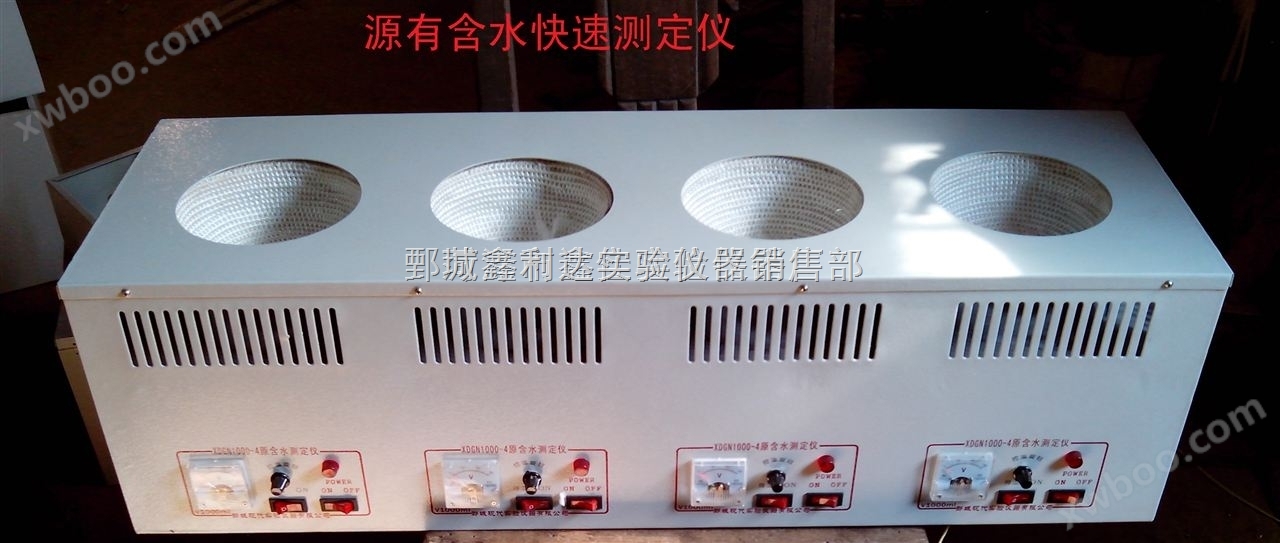
Crude oil water content analyzersummary:
The product is a floor standing integrated multifunctional measuring device. This can simultaneously measure 4 oil samples and 6 oil samples. Zui is suitable for single well testing in oil production teams with large assay volumes
Crude oil water content analyzerProduct features:
1. The shell adopts cold-rolled sheet deep drawing and surface electrostatic spraying technology.
2. Automatic temperature control with digital display, featuring a large heating area, fast heating, uniform temperature, precise temperature control, and time-saving and labor-saving features.
3. Corrosion resistance, aging resistance, durability, safety and reliability.
4. It has a novel and beautiful design, easy operation, and good usability.
Technical performance:
No need to build a laboratory bench, easy to move, one machine for multiple purposes, the entire laboratory procedure can be completed on one machine; No need for tap water, no need to equip heating equipment such as electric heating plates and water baths; Magnetic demulsification, fast oil-water separation, no sample flushing or sudden boiling in the determination of medium and high water content; Safe and energy-saving, easy to use, no need for manual monitoring, and will automatically shut down when needed. Operating voltage: 220V. Maximum power: 5KW
Specifications: 500ml. 1000ml
foreword
DGN seriesRapid determination instrument for crude oil water contentIt is a type of automated crude oil water content measurement device. According to the requirements of national measurement standards, a DGN1000 crude oil water content rapid analyzer has been developed on the premise of producing HL500 type. It not only overcomes the disadvantages of traditional measuring instruments such as difficult temperature control, easy sample flushing, high energy consumption, low efficiency, and insecurity.
The product has been tested by experts from Shengli Oilfield and Zhongyuan Oilfield, and it is believed that this instrument has complete performance, high degree of automation, safety, energy saving, and easy operation. It is a reliable instrument for various oil production manufacturers, gathering and transportation stations, scientific research units, and oil post laboratories.
1DGN series crude oil water content rapid analyzerCharacteristics and working principle of
1. This instrument adopts a heating sleeve for non open flame heating, with fast heating, low power, uniform heating, and high efficiency.
2. Magnetic stirring is a closed magnetic stirring method that avoids sudden boiling and achieves rapid oil-water separation.
3. In the automation and self-control parts, the timer is the heating power switch, which sets the required time and automatically shuts down the power when the time is up. By using gas sensing probes instead of manual monitoring, if the height of oil and gas rise exceeds the specified standard, the instrument automatically cuts off the power supply and starts the axial flow fan to quickly cool down the furnace body, thereby avoiding the phenomenon of sudden boiling and sample collision and achieving safety.
4. Equipped with a pure water automatic cooling tank, it prevents the yellowing and scaling of glass instruments, and solves the problem of water shortage in field operations.
5. The DGN model is equipped with a glass instrument quick drying oven and a heating air duct for condensing air drying. In order to address the impact of external cold air on the receiver, it is equipped with a temperature protection device, which solves the problem of premature condensation of water vapor and backflow of water droplets, achieving the goal of rapid evaporation of moisture. HL1000 model, equipped with XA hot air flow rapid constant temperature dilution instrument, it can heat 6 samples at once and also dry glass instruments.
IIindicate
This instrument relies on high-temperature distillation to increase the temperature of crude oil, making the temperature of water in the oil reach over 100 degrees, turning it into steam and then magnetizing it to allow the iron substances in the oil to rotate at high speed, quickly separating emulsified water and evaporating water in the oil, achieving the purpose of rapid measurement. Therefore, the diluent added should not exceed 150 grams (sample 200 grams), otherwise a large amount of light component gas will quickly enter the condenser tube. Once it encounters the gas sensing probe above, the instrument will automatically stop heating and enter a cooling state, which cannot achieve the rapid effect. Due to differences in scale, facilities, and workload among different units, the DGN (HL) series comes with the following specifications for reference:
model |
specifications |
Amount |
Dilution amount |
voltage |
Measurement time |
Quantity of samples tested |
accuracy |
DGN500B2 type |
500ⅹ2 |
10 g |
25 grams |
220V |
12-15 |
2 |
100% |
DGN500B2 type |
500ⅹ6 |
10 g |
25 grams |
220V |
12-15 |
6 |
100% |
DGN500D type |
500ⅹ12 |
10 g |
25 grams |
220V |
12-15 |
12 |
100% |
DGN500B1 type |
500ⅹ4 |
10 g |
25 grams |
220V |
12-15 |
4 |
100% |
DGN1000 type |
1000ⅹ2 |
20 grams |
100 grams |
220V |
20-25 |
2 |
100% |
DGN1000 type |
1000ⅹ6 |
20 grams |
100 grams |
220V |
20-25 |
6 |
100% |
DGN1000 type |
1000ⅹ4 |
20 grams |
100 grams |
220V |
20-25 |
4 |
100% |
Due to the different water content of crude oil, the sampling amount also varies. For example, if 100 grams of crude oil is taken, 40 grams to 50 grams of diluent can be added. If 50 grams of crude oil is taken and 30 grams of diluent is added, the distillation time remains unchanged. For HL1000 type, 100 grams of crude oil and 60 grams of diluent can be taken.
The purpose of crude oil determination is to completely separate oil and water and accurately measure the water content of crude oil. Therefore, whether it is rapid or long-term distillation, only accurate values can meet the requirements. Users can use HL1000 series products to compare the results with other instruments. If there is indeed an error in this product, our factory is responsible for repairing or returning it. Practice has shown that using HL1000 instruments can achieve the accuracy measured by the original instrument in 60-90 minutes in just 20 minutes, saving 2.6 times the solvent and 5 times the electricity, and improving work efficiency by more than 4 times. If users have strict regulations on distillation time and solvent addition, they can also use this product to add 400 grams of solvent gasoline (xylene) for long-term distillation. The specific operation method remains unchanged, but the voltage is adjusted to 150V. Just enough. Our factory implements three guarantees for our products from the date of shipment, including training and installation, and a two-year free warranty.
IIICombination installation method
1. Main components: The instrument body is divided into three parts: ① rapid measuring instrument ② condenser bracket ③ purified water automatic cooler, glass moisture analyzer, cooling water conduit, etc. The XA type hot air flow crude oil rapid constant temperature dilution instrument is an important accessory.
2. Place the measuring instrument on the laboratory table, and then insert the condenser bracket into the square holes on both sides of the measuring instrument.
3. The condenser bracket is a push-pull bracket. During installation, the entire set of glassware can be placed inside the heating sleeve to check if it is vertical. If it is not vertical, the bracket ring can be moved left and right to correct it, achieving free loading and unloading, and then the screws can be tightened. The tightness of the condenser tube clamp should be such that the condenser tube does not slide down.
4. Purified water circulating cooler. Installation can be designed according to the length conditions of the laboratory bench. Place it flat with the measuring instrument and on the right side of the measuring instrument. If the laboratory table is too small, it can also be placed on the ground below the table.
5. Connection of cooling water conduit: The connection method is series connection, which refers to connecting the upper opening of the circulating water outlet group * and the lower opening of the second group, and then connecting the lower opening of the remaining group * to the condenser water nozzle, and connecting the upper opening of the second group to the cooling water return pipe.
6. Connection and setting of the cooler: Turn off the two switches on the cooler panel, plug the power plug directly into the power socket on one side of the cooler, and connect the other end to the AC power supply. (Cooling and circulating water can be controlled separately and do not affect each other.) Turn the switch of the cooling digital instrument to the upper limit position (above), and then rotate the corresponding upper limit setting potentiometer knob. At this time, the desired upper limit temperature value will be displayed, usually set at 20 ℃. Turn the switch to the lower limit setting position (below) and then rotate the corresponding lower limit setting potentiometer knob. At this point, the desired lower limit temperature value is displayed, usually set at 10 ℃. The difference between the upper limit set temperature value and the lower limit set temperature value should not be less than 5 ℃. After setting, turn the switch to the measurement position (middle), and the actual temperature value will be displayed. Turn on the cooling switch to start working without manual control Add more than three-quarters of water into the stainless steel bucket. Then turn on the switches separately and test the circulating water and cooling compressor separately. When testing the circulating water pump, immediately listen to whether the pump starts after turning on the switch. If it does not start, there will only be a slight sound, which is often caused by long-term disuse. The impeller inside the pump is stuck and cannot rotate. The power supply of the pump should be turned off immediately to prevent the pump from being burned out by prolonged power on. Use a small stick about 30 centimeters long at the outlet to gently poke the impeller inside the pump to make it move, and then turn on the power for testing. Some water pumps come with a movable screw at the end of the factory, so there's no need to poke it with a small stick. Just use a screwdriver to tighten it. The cooler automatically starts and shuts down under the control of the measuring instrument (it can also be manually turned off but cannot start automatically).
4Operating procedures
1. The power of each thermal group of the instrument is equal, and there is only one probe. When in use, after each group of oil samples is prepared, they must be loaded into the heating sleeve of the instrument and heated for distillation at the same time, otherwise the timer will lose its timing function.
2. The loading and unloading methods of the flask, receiver, and condenser tube: After the crude oil and diluted gasoline are loaded, the flask must be held by hand, and the receiver must be inserted into the flask with the left hand. Observe whether the grinding mouth of the flask and the grinding mouth of the receiver are tightly combined, otherwise there will be air leakage. Use your left hand to push the condenser tube up to the top dead center, and your right hand to push it up. Insert the grinding mouth on the top of the receiver and the grinding mouth on the bottom of the condenser tube tightly into place. Align your left and right hands with the heating sleeve and apply slight force until the bottom of the flask and the bottom of the heating sleeve are tightly combined.
3. The usage method of automatic control probe: The probe is a substitute for manual monitoring of guards. Its principle is that oil and water are heated, and the oil and gas rise and come into contact with the probe to function. When in use, it must be inserted into the upper 1/3 of the heating condenser tube, otherwise it will not function automatically. The digital temperature control meter corresponding to the probe, such as a "voltage regulating instrument", should generally set the temperature at 60 degrees. For the "No Voltage Adjustment Instrument", the temperature should be set at around 35 degrees, relying on the principle of repeated oil sample flushing to accelerate oil-water separation. This temperature can be determined according to the actual situation of flushing. If the oil sample is flushed to 3/4 of the condenser tube, the temperature of the temperature control instrument can be set lower. If the oil sample is not flushed to 1/2 of the condenser tube, the temperature of the temperature control instrument can be set higher. These situations are related to the ambient temperature and oil sample density. Therefore, it needs to be flexibly applied. The adjustment of the intelligent temperature control meter is described in the following instructions.
Attention: Be sure to see the convex groove on the probe clearly, align it and apply slight force, and slowly insert it. If the probe is not inserted into the instrument, the instrument cannot function properly. However, after inserting the probe, it can be placed behind the instrument instead of in the condenser tube.
4. Timer operation method: The timer has both mechanical timing and digital instrument timing. The mechanical timer is the main power switch of the instrument. When using it, it must be rotated clockwise. Align the white line with the scale on the instrument panel and release it. The timer will automatically reverse the timing. When the set time is up, it will automatically shut down. Do not rotate counterclockwise. Reverse it to normally on and will not automatically shut down.
The instrument timer is the power switch for the heating and blowing cooling of the instrument. When using, first adjust the middle time (h), minutes (m), and seconds (s) of the digital display in the timer, and then set the time. When the power is turned on, the digital display will start counting from zero. Once the set time is up, the heating will automatically stop and the blowing cooling will begin. The digital display will maintain the current number, achieving timed control. Reset the time, or turn on the reset switch on the left side of the timer at any time, and then immediately turn it off to start counting again from zero. If you don't want to time, you can set the time to the maximum of 99 hours.
The meaning of time digits: ① When the middle of the digital device is set to (h), it represents the hour, and the timing range is 1 minute to 99 hours and 99 minutes (the first digit represents the hour, and the last digit represents the minute).
② When the middle of the digital device is set to (m) hour clock minutes, the timing range is 1 second to 99 minutes and 99 seconds (the first digit represents minutes, and the last digit represents seconds).
③ When the middle of the digital device is set to (s) hour clock seconds, the timing range is 0.01 seconds to 99.99 seconds (the first digit represents seconds, and the last digit represents 0.01 seconds).
5. Voltage adjustment method: Voltage adjustment is also an adjustment of heating power. *For secondary use, adjust the voltage to 160V (observe the reading on the instrument voltmeter). After heating for five minutes, observe the height of the oil and gas rising in the condenser. Generally, the height should be in the middle of the condenser. If you cannot reach this height, you can slightly adjust the pressure knob clockwise until the oil and gas stabilize at 1/2. Remember this reading, use it again next time, adjust it according to this voltage once, and generally do not touch it.
6. The usage method and regulations of the mixer: There are two types of this instrument: full mixing and single group mixing. It is determined based on the amount of oil taken. This instrument has two stirring functions, one is magnetic stirring and the other is iron ion stirring. If taking less than 50 grams of crude oil, only one stirrer should be placed in each instrument, and the designated set of heating flasks should be placed. Other groups do not need to have agitators, just rely on the iron ions in the crude oil to stir. If 100 grams of crude oil are taken, each group must have a stirrer. Each bottle can only contain one mixer.
7. Method to start stirring: Due to the continuous rotation of the stirring magnetic field, the temperature and viscosity of the newly added crude oil are very low, and the stirring element is stationary. At this time, the stirring element may not necessarily rotate. After heating for 1-2 minutes, the crude oil is diluted, and then press the magnetic stirring switch downwards, gently turn the speed control knob, and all stirring elements will start.
8. Comprehensive use and inspection: After connecting the power, turn the function key to the automatic control position, and the instrument power indicator light will turn on, indicating that the power has been connected. When each group needs to heat and distill the oil sample, put it into the heating sleeve of the instrument, turn on the switch for each group that needs to be heated upwards, and rotate the timer clockwise (the white line on the knob points to the 12-15 minute mark for the required time). At the same time, the cooler automatically starts, and the heating indicator lights for each group that needs to be heated are on, indicating that it is working. When the set time is up, it will automatically shut down and the reading will be ready.
5、 Emergency troubleshooting
1. If the operation is improper or too much oil is taken, the diluted gasoline preparation is incorrect, causing sample flushing and crude oil flushing into the receiver, manual control can be used: immediately turn the function switch to the sample cooling position. The instrument will automatically power off and at the same time turn on the fan to quickly cool down the heating part through air cooling. Distillation can continue after the temperature drops.
2. During the distillation process, if blue smoke is found to be emitted from the heating jacket, it indicates that the bottom of the flask has exploded. The heating jacket must be turned off and the flask must be removed. Do not continue distillation. If crude oil has already flowed into the heating jacket, adjust the voltage to 70V and slowly heat and evaporate until there is no smoke. Only then can it continue to be used. Otherwise, this heating sleeve will quickly burn out.
3. If the timer is found to be damaged, it does not affect its use, but it cannot time. At this point, rotate the timer counterclockwise to the normally on position for use. Whether the crude oil has been completely distilled can be checked by whether there are water droplets on the inner wall of the flask. No water droplets indicate that the water in the oil has completely evaporated.
VIprecautions
1. Before use, it is necessary to carefully read the instruction manual. Operate according to the instructions, do not open or ask other manufacturers for repairs without authorization, otherwise our factory will not be responsible.
2. It is normal to have white smoke and odor during repeated use.
3. Due to differences from traditional distillation methods, the cooling water flow rate must be increased, and it is strictly prohibited to change the gasoline dilution ratio of the new distillation method.
4. This instrument is for rapid distillation and cannot use a 30cm fine mouth (12 #) condenser. Moisture determination must be performed using a diameter of 19 # or higher
|