
VIP member

CS-10 precision colorimeter
Test color difference step: Place the instrument steadily on a flat object and conduct the test
Product details
Test color difference steps
Place the instrument steadily on a flat object for testing.
Step 1: Black calibration test
Step 2: White calibration test
Step 3: Test the standard sample
Step 4: Testing and Testing
After the test is completed, the chromaticity and color difference values are obtained,
Chromaticity values: L * a * b *, L * c * h *, Δ E * ab, XYZ, relative RGB values;
Color difference values: Δ (L * a * b *), Δ (L * c * h *)
Product Features
1. The lowest price in China;
2. Large font interface, data is clear at a glance;
3. Easy to operate and convenient to measure;
4. Black and white calibration for more accurate testing;
5. Measuring caliber of 8mm, vertical structure, more intuitive testing;
6. Low power consumption, making the instrument more energy-efficient;
7. Comes with a matching computer color management software, making your color management more convenient;
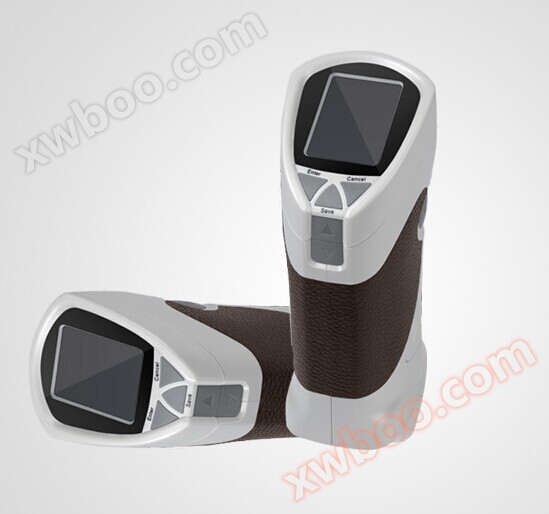
Technical Specifications
Lighting receiving system |
8/d (8 ° illumination/diffuse light reception), including specular reflection light (SCI) |
display mode |
Chromaticity values: L * a * b, L * C * h, △ E * ab, XYZ, relative RGB values; |
Measuring caliber |
Approximately 8mm in diameter |
measurement conditions |
CIE 10 ° standard observer, CIE D65 light source |
measurement range |
L*:1-100 |
repetitiveness |
Standard deviation △ E * ab *, within 0.08 (measurement conditions: measure the white calibration plate 30 times and take the average) |
storage |
10 sets of standard samples, 100 sets of test groups under each standard sample |
measure time |
About 0.5 seconds |
Measuring light source |
LED light source |
Interface language selection |
Chinese, English |
power supply |
4 AA 1.5V alkaline batteries or nickel hydrogen batteries, dedicated adapter DC5V |
interface |
USB 2.0 printer |
weight |
550g |
size |
77×86×210mm |
Online inquiry
-
Contacts
-
Company
-
Telephone
-
Email
-
WeChat
-
Verification Code
-
Message Content
-