VIP member
Application of Infrared Scanning Thermal Imager PYROLINE in Oil Felt Production Control
Application of Infrared Scanning Thermal Imager PYROLINE in Oil Felt Production Control
Product details
Infrared scanning thermal imager
Application of PYROLINE in Oil Felt Production Control
In order to produce sturdy and durable oil felt floor covers, all production process parameters need to be correct, which is very important.
In the first step of production, the desiccant and resin are mixed into the oil felt adhesive and begin to heat up. Then, fillers and several colorants are added to add color.
This mixture is then heated to a specified temperature range. Because this mixture needs to be transported on a wider conveyor belt, and the speed is also higher than
It is not possible to use contact temperature measurement quickly.
In the process of modernizing machines, old style infrared thermometers have been replaced by new and advanced German DIAS infrared scanning thermal imagers
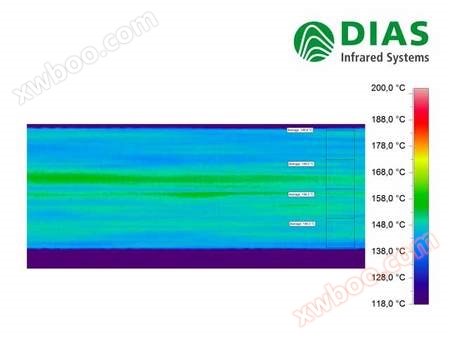
PYROLINE has completely replaced it. This infrared scanning thermal imager can ensure fast, non-contact, high-precision temperature measurement, necessary measurement
The temperature range is from 100 ° C to 200 ° C.

We divided the measured temperature into 4 zones and transmitted the highest temperature of these 4 zones to the process control system, thereby adjusting these temperatures
Perform control. In this way, our infrared scanning thermal imager has been integrated into the entire oil felt closed-loop control system, which is beneficial for
The quality of oil felt products is very important.
After measuring the temperature, the felt material is processed into sheets and coated with hot wax, which makes the felt strong and durable, and can resist mechanical influences.
Next, the waxed linoleum board is cooled by spray. After cooling, use another infrared scanning thermal imager to monitor the temperature of the oil felt and its temperature
Degree distribution. Afterwards, the oil felt is cut or punched into the size required by the end user.
Online inquiry
-
Contacts
-
Company
-
Telephone
-
Email
-
WeChat
-
Verification Code
-
Message Content
-